
ClearSignal
ClearSignal

AI is moving into freight operations with increasing speed. Customers are beginning to expect faster responses, clearer visibility, and fewer inconsistencies across shipments. Internally, teams are under pressure to process higher volumes without a proportional increase in experienced personnel. Externally, partners are operating with tighter timelines and less tolerance for ambiguity. These shifts are not theoretical. They are already affecting how freight businesses are evaluated—commercially and operationally. Organisations that adopt AI in a structured way are able to respond with greater consistency, reduce reliance on manual reconciliation, and maintain alignment across increasingly complex workflows. Those that delay adoption are not only slower in execution; they begin to fall out of step with customer expectations and partner requirements. The question is less about whether AI will be used, and more about how it is positioned within the operation. Cost is often the first consideration. In practice, the more relevant measure is where value is currently being lost—through missed charges, rework, delayed billing, and operational inefficiencies that accumulate across the shipment lifecycle. AI, when applied with structure, addresses these areas directly.
The return is not isolated. It compounds across volume. → See ROI

Maintaining the integrity of a shipment as it moves across people, systems, and external parties. Freight operations rely on continuous coordination. Across customers, internal teams, and service partners, the same shipment is handled through multiple interactions. Each interaction introduces variation. Over time, alignment depends less on structure and more on reconstruction. ClearSignal defines and embeds an Operational Continuity Layer to stabilise that movement—so the shipment that is agreed remains consistent through execution and billing.

A structured assessment of how shipments and information move across the organisation. The focus is on the actual path of work—across sales, customer service, operations, accounts, and external parties such as carriers and truckers. Attention is given to where information is incomplete at handover, where clarification is repeatedly required, and where decisions rely on interpretation rather than confirmed inputs. This establishes a clear view of how context changes over the lifecycle of a shipment, where those changes begin to affect outcomes, and where control points need to be introduced. The output is a working map of operational flow, with identified points of drift, impact on margin and service, and defined conditions for continuity.
The Operational Continuity Layer functions as a constant presence across the workflow. It carries forward the role typically held by experienced personnel—ensuring that what is required is present, that instructions remain aligned, and that gaps are surfaced before they propagate. Each handover is validated against defined conditions. Variations are made visible at the point they occur. This creates a consistent operational posture across functions. The shipment progresses with continuity, rather than being reinterpreted at each stage.
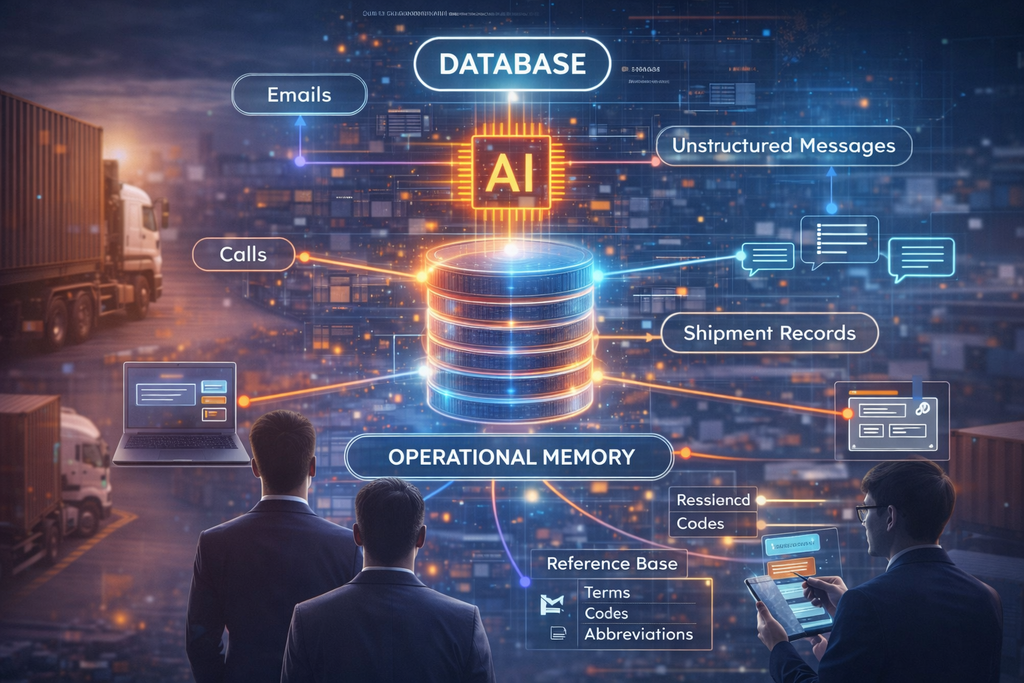
Communication is captured as part of execution and formed into structured data. Over time, this builds a shipment-level record that reflects actual decisions, instructions, and outcomes. Alongside this, a reference base develops—covering terms, codes, abbreviations, routing patterns, and recurring conditions specific to the business. This serves both human operators and AI processes. It provides a grounded reference for checks, validation, and decision support, based on how the operation actually runs rather than how it is assumed to run.
AI operates within defined boundaries. Data usage is controlled in line with commercial sensitivity. Access to customer, pricing, and routing information is explicitly managed. Outputs are visible and traceable. Decision accountability remains with the business. Consideration is also given to organisational and regulatory factors, including internal policy alignment and ESG expectations. The objective is to introduce capability without exposing the operation to unmanaged risk. These controls are established as part of design and remain active in operation.
ClearSignal defines the Operational Continuity Layer and works alongside existing systems and selected partners to embed it into live operations. The focus remains on alignment—ensuring that workflows, systems, and participants operate against the same conditions of completeness and continuity. The scope is specific: stabilising how shipments move, rather than broad transformation of the business.
ClearSignal is built on three decades of experience in freight and logistics, across both independent operators and global organisations. That experience reflects how freight businesses actually function—through accumulated practice, distributed knowledge, and processes shaped over time. It also reflects where strain appears as operations scale or become more complex. The work focuses on bringing structure to that environment—so that continuity is maintained without relying on individual interpretation, and operational performance remains consistent as the business grows.
Investment in AI is often evaluated as a technology cost. In freight operations, the more accurate view is operational recovery. Value is typically realised across four areas:
Revenue Capture
Missed or delayed charges are reduced as execution and billing remain aligned.
Even a small recovery rate applied across shipment volume produces measurable uplift.
Reduction in Rework
Time spent clarifying, correcting, and reconciling is reduced.
This directly improves productivity without increasing headcount.
Cycle Time Improvement
Faster progression from quotation to execution to billing improves cash flow and operational throughput.
Operational Stability at Scale
As volume increases, the operation does not rely proportionally on experienced individuals.
This reduces hiring pressure and onboarding risk. The return is not dependent on a single outcome.
It emerges from removing friction across the lifecycle of every shipment.